Anti-Financial Crime Summit 2026: Five Takeaways on Fraud and AML
Reading time: ~6 minutes · For AML, KYC, sanctions, fraud and FIU professionals
On 7 October I attended the AML Intelligence International Anti-Financial Crime Summit at the Hilton London Tower Bridge. The room was smaller than I expected, which left more time for proper conversations.
Across the day, from FATF, the regulators and the banks, three messages kept coming up:
- Fraud is moving to the top of the agenda.
- Controls will be judged on results, not on whether they exist on paper.
- No firm can fight financial crime alone, so information has to be shared faster.
Here are the five themes I took away, and what each could mean in practice for firms.
1. FATF puts fraud first
FATF President Giles Thomson made the point that fraud has always been a predicate offence for money laundering. What has changed is the scale. Technology lets criminals run fraud like an industry, across borders, while traditional methods such as cash and front companies remain in use. Firms have to deal with both.
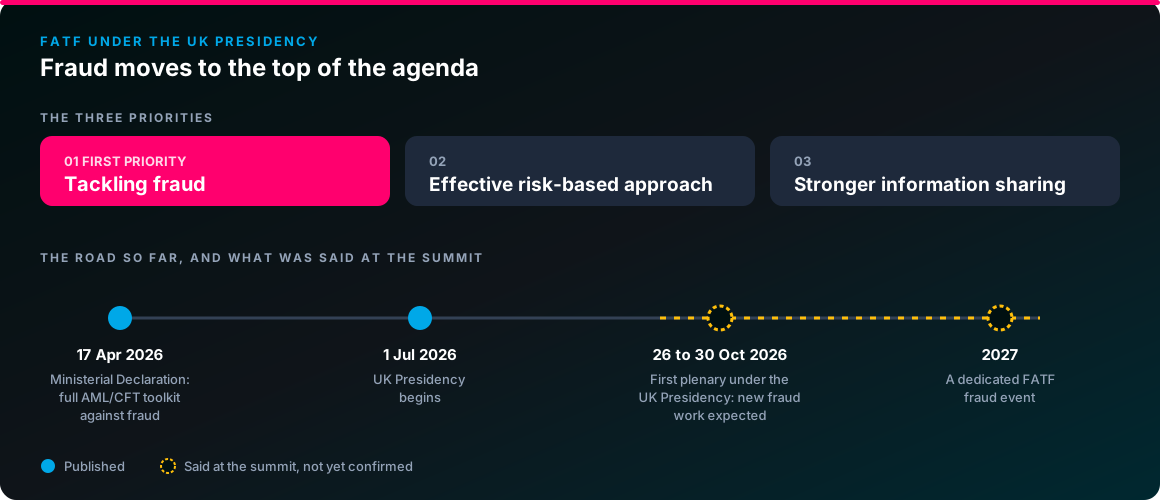
Under the UK Presidency, which began on 1 July 2026, fraud sits first among FATF’s priorities, alongside a more effective risk-based approach and stronger information sharing. It follows the April 2026 FATF Ministerial Declaration, in which ministers committed to using the full AML/CFT toolkit against fraud.
It was said at the summit that new FATF work on fraud is expected at the October plenary, running from 26 to 30 October and the first under the UK Presidency. A dedicated FATF event on fraud in 2027 was also mentioned.
On the risk-based approach, the message was to simplify controls where risk is low and focus effort where it is high. FATF plans to share more examples of good practice to support firms in doing this.
What this means in practice: fraud is likely to receive the same international attention as money laundering and terrorist financing. Firms can get ahead of supervisory questions by mapping where their fraud and AML controls connect today, and, as FATF publishes more good practice examples, use them to simplify low-risk processes with confidence.
2. Fraud and AML are converging, and the rules are catching up
On the UK panel, banks described bringing fraud and AML teams, data and systems closer together, a shift often called FRAML. Now that FATF has made fraud a priority, they would welcome clearer guidance on how to do it.
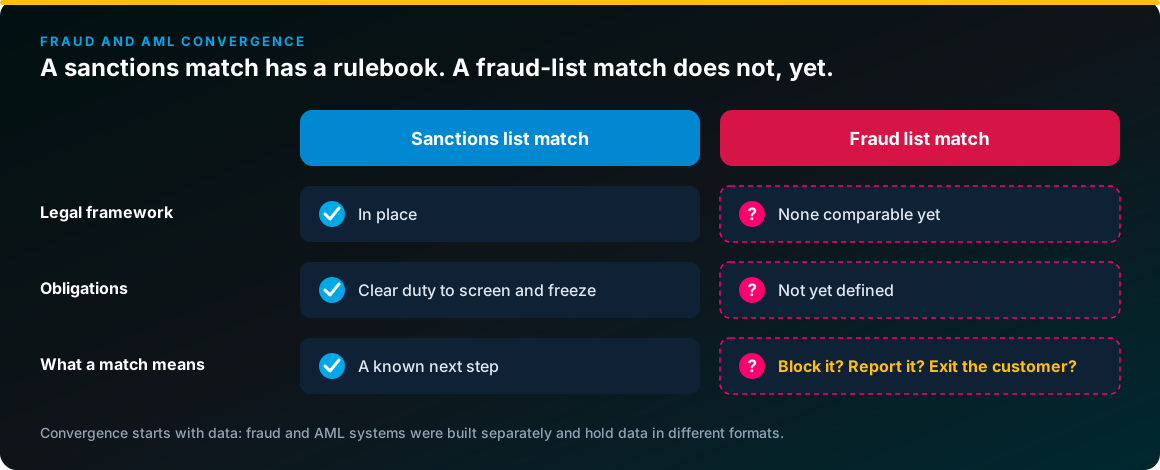
Carolina Garcés-Monterrubio raised a point that stayed with me. Some countries now publish fraud-specific lists, but these don’t have a legal framework like sanctions lists do. A sanctions match comes with clear obligations to screen and freeze. With a fraud-list match, banks don’t yet know whether the right response is to block the payment, report it, or exit the customer.
The panel saw data as the enabler. Fraud and AML systems were built separately and hold data in different formats, so convergence starts with common, clean data. Crypto remains a shared challenge.
What this means in practice: aligning fraud and AML data is a sensible first step, and a useful one whatever form the guidance takes. Firms that receive fraud-list data can also document how they handle a match today, so decisions are consistent and easy to revisit as guidance develops.
3. The FCA will judge controls on results
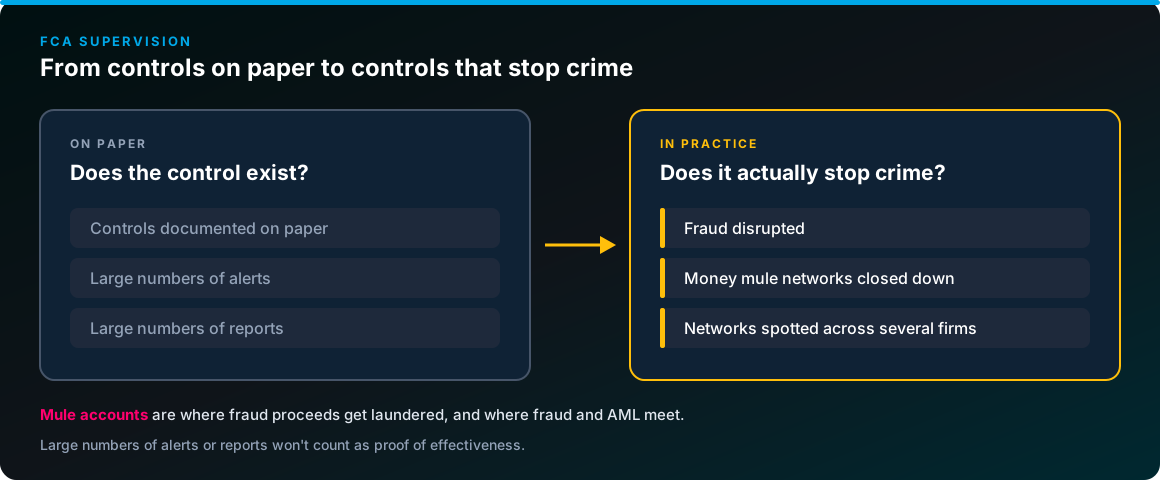
Beth Harris, Head of Financial Crime Specialist Supervision at the FCA, described a shift from checking whether controls exist on paper to asking whether they actually stop crime. Large numbers of alerts or reports, she said, won’t count as proof of effectiveness.
The FCA is also looking across the whole system rather than one firm at a time, to spot networks that use several firms. Its priorities are disrupting fraud and closing down money mule networks. Mule accounts are where fraud proceeds get laundered, which makes them the place where fraud and AML meet.
Her central message was that criminals exploit the gaps between firms and sectors. She used two short phrases: “remove the criminal advantage” and “act together”.
What this means in practice: management information built around volumes may need to evolve. There is an opportunity to show outcomes instead: what your controls actually stopped or disrupted, particularly around mule activity.
4. Information sharing is the main gap, and Italy offers a model
Fraud and laundering networks use accounts at many banks at once, so no single bank sees the full picture. FATF wants faster sharing between banks, and between banks and the authorities, within data protection rules.
In the UK, the Economic Crime and Corporate Transparency Act 2023 gives firms legal cover to share information to prevent economic crime, and it was noted at the summit that the FCA is encouraging firms to use it.
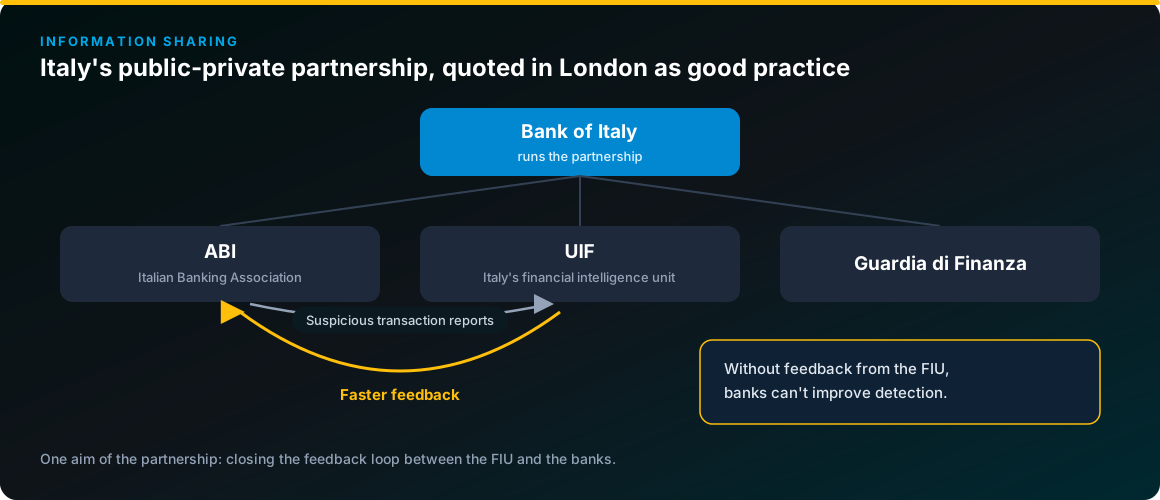
Italy was quoted as a good example. The Bank of Italy runs a public-private partnership with the Italian Banking Association (ABI), the UIF, Italy’s financial intelligence unit, and the Guardia di Finanza. One aim is faster feedback from the FIU to banks. Banks file suspicious transaction reports but usually hear little back, and without feedback they can’t improve detection.
Cross-border sharing is harder, because the same typology can be defined differently in each country. Common definitions are needed, and AMLA’s work on EU-wide standards should help.
What this means in practice: UK firms can review whether they are making full use of the ECCTA information-sharing provisions. More broadly, any FIU feedback a firm does receive is worth feeding straight into detection tuning, and aligning typology definitions across your own jurisdictions is a practical step towards the common definitions cross-border sharing needs.
5. Regulators welcome AI, with conditions
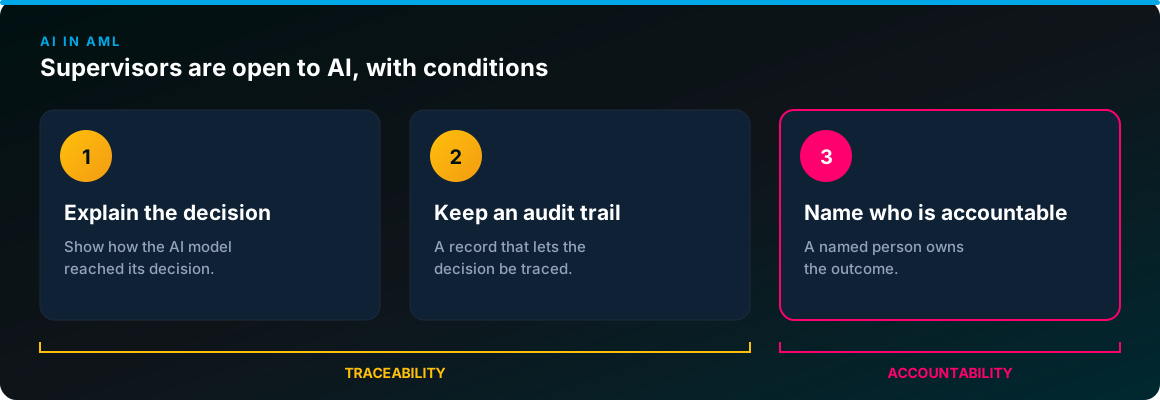
Supervisors at the summit were open to technology and innovation, including AI. The conditions were traceability and accountability: a firm must be able to explain how an AI model reached a decision, keep an audit trail, and keep a named person accountable for the outcome.
What this means in practice: these conditions are easier to meet when they are built in from the start. Explainability, audit trails and clear ownership belong in the design of an AI project rather than being added after deployment.
My view: real-time payments mean round-the-clock monitoring
The point I keep returning to since the summit is what these themes mean for real-time payments. If payment checks are to combine fraud and AML requirements, monitoring effectively has to run 24 hours a day, seven days a week. It can also add friction to payments. That is a real operational challenge.
AI agents are one possible way to support continuous, round-the-clock monitoring. If that is the direction firms take, the conditions supervisors set out at the summit apply in full: explainable decisions, a complete audit trail and a named person accountable for the outcome.
So I would be interested to hear how your team is approaching it: how are you balancing round-the-clock monitoring with payments that never stop?
Want to build the judgement behind these controls?
The FinCrime Career Accelerator develops practical judgement across sanctions, FIU, MI reporting, QA and CDD, in 10 practical modules.
Explore the FinCrime Career AcceleratorFor a weekly roundup of the financial crime stories that matter, see FinCrime Intelligence Weekly.